
Warner Music
Transforming their financial operations with a Shared Service Center
My Role
Lead Product Designer
Scope
Enterprise Software
Responsibilities
Research, Strategy, Design, Testing
Timeline
16 months (Sep’20 - Dec '21)
View Details
Overview
Warner Music, with over 4500 employees in the world, was struggling with its internal customer service. There was no system for their Agents to manage the enormous amount of financial and accounting requests.
As the Lead Product Designer, I created a Shared Service Center to standardize their service flows and empower the requestor to achieve self-service. Also, I initiated automation in their file handling process to reduce unnecessary manual work.
Problem
In the past decades, Warner Music’s Finance and Accounting departments have been relying on emails and phone calls to collect internal requests. As the company expands, the departments found it very challenging to keep track of thousands of daily requests around the globe. There is no standardized system, which hinders them from improving their internal customer service and working efficiency.
When the teams handle the requests, it often involves a high time and labor cost due to ineffective communication and unnecessary data entry and formatting.
Research
Stakeholder Interviews
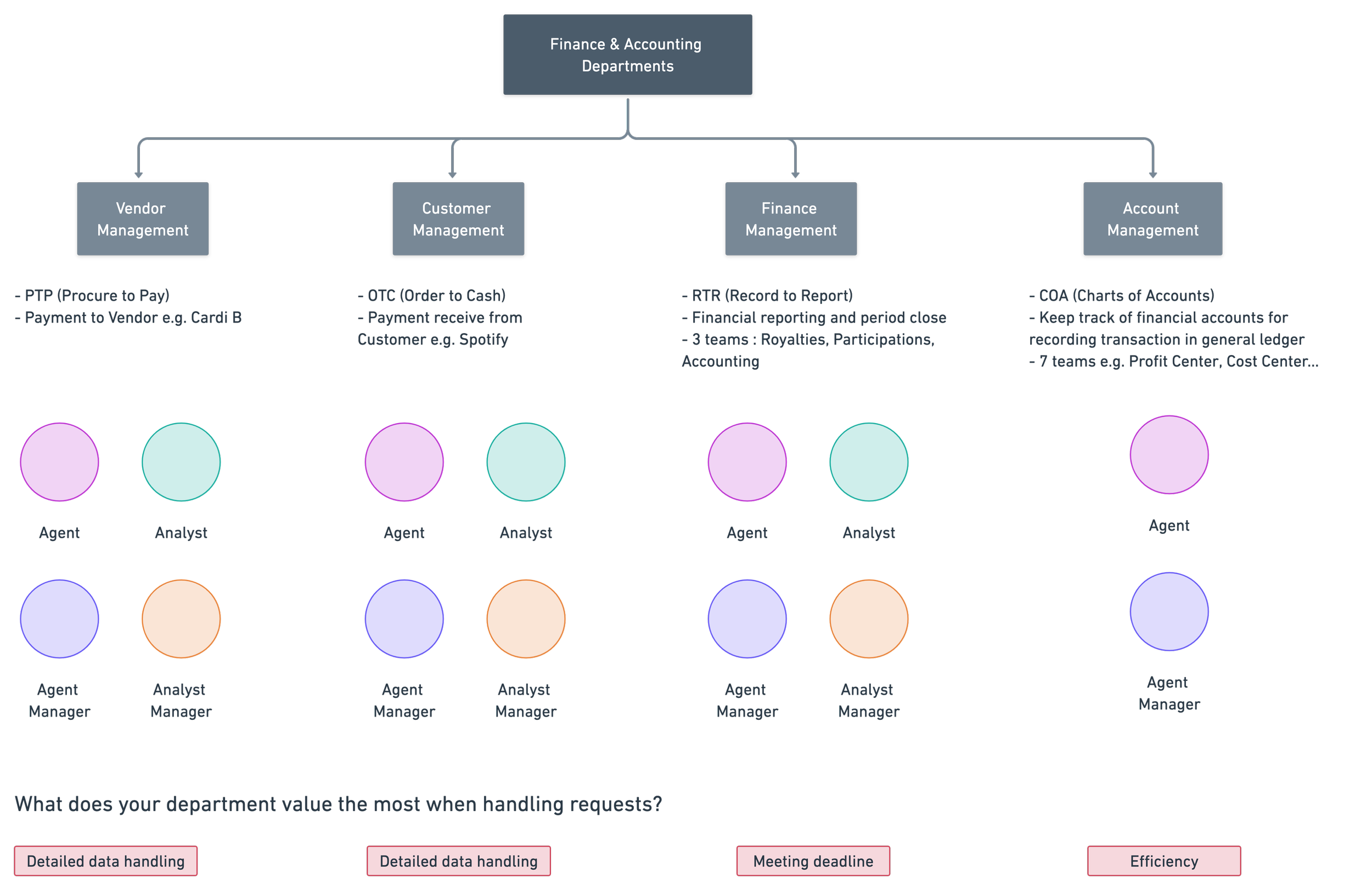
To have a deep understanding of their problems, first, I learned about the department's structure. The Finance and Accounting departments have 4 management teams. After talking to each department’s heads, I learned about the teams’ main functions and key positions.
In the interviews, I asked what their departments value the most when handling requests.
It’s interesting to see how each department is different from one another. While Vendor/Customer Management values taking the time to collect every single detail from the requestor, Account Management focuses on learning about the big picture and efficiency.
Workflows
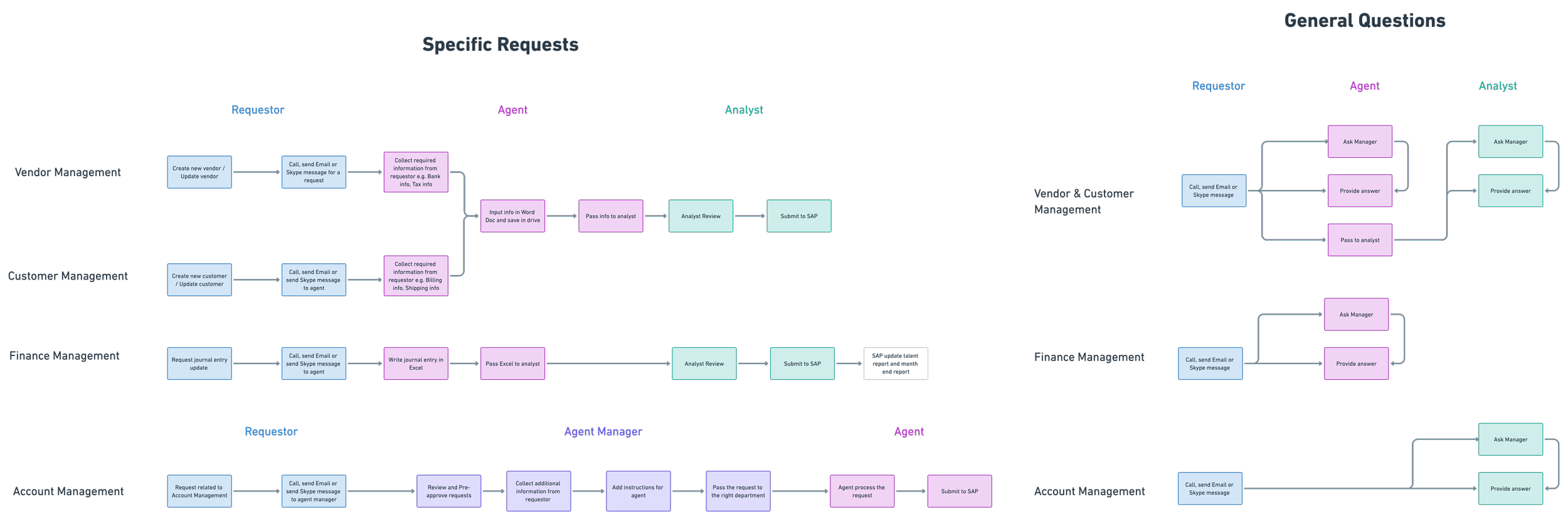
Next, I learned about how each team handles specific requests and general questions.
Key findings:
For specific requests, Vendor/Customer/Finance Management Teams have similar workflows. Requestor sends requests to Agent. Agent would process the request and hand it over to Analyst to review.
One thing that is unique to the Account Management team is, they would first have Agent Manager filter the requests and then they will send the request to Agent to process.
Learning their similarities and differences is essential to ideate the structure of the shared service model in the later stage.
Peronsas
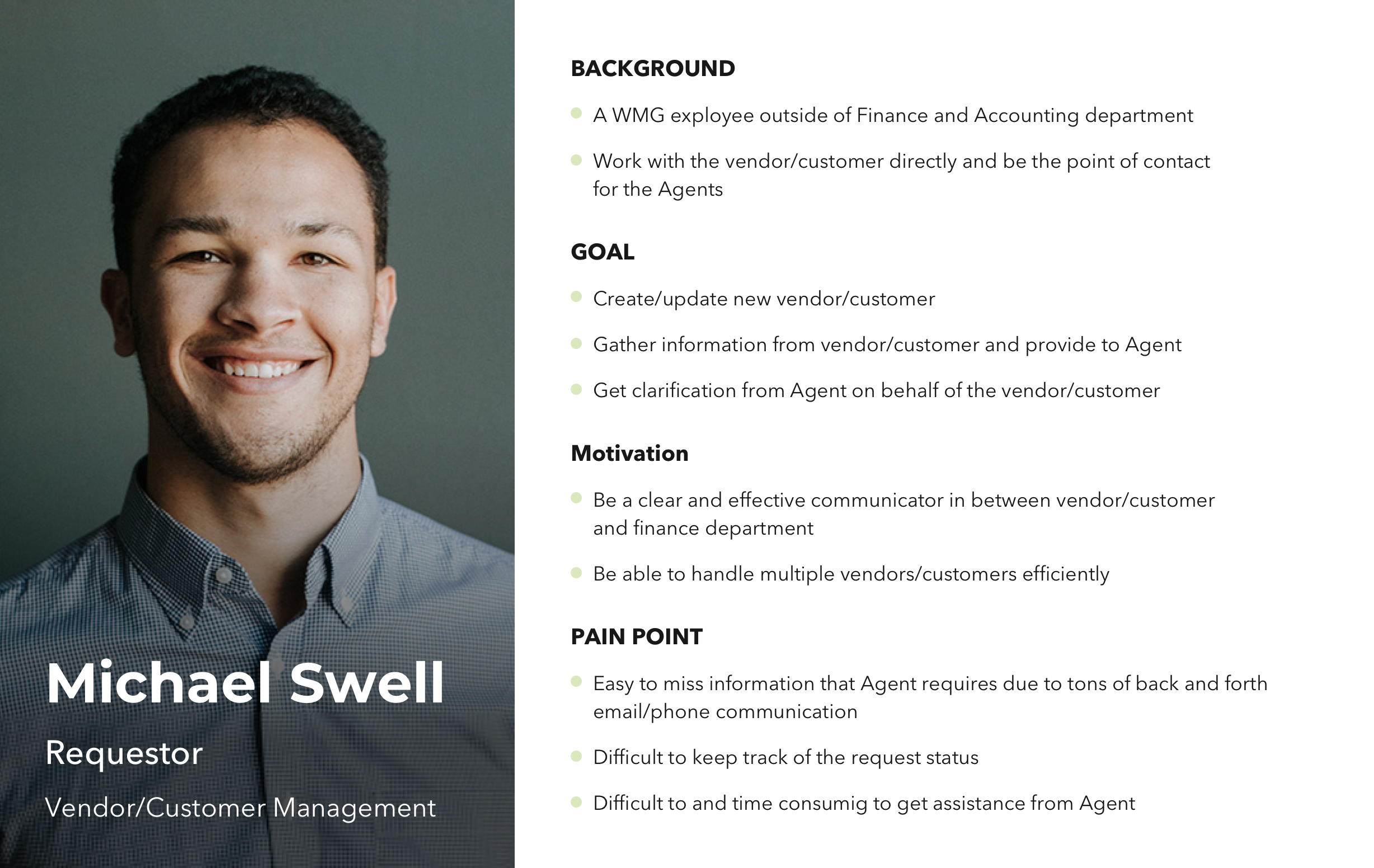
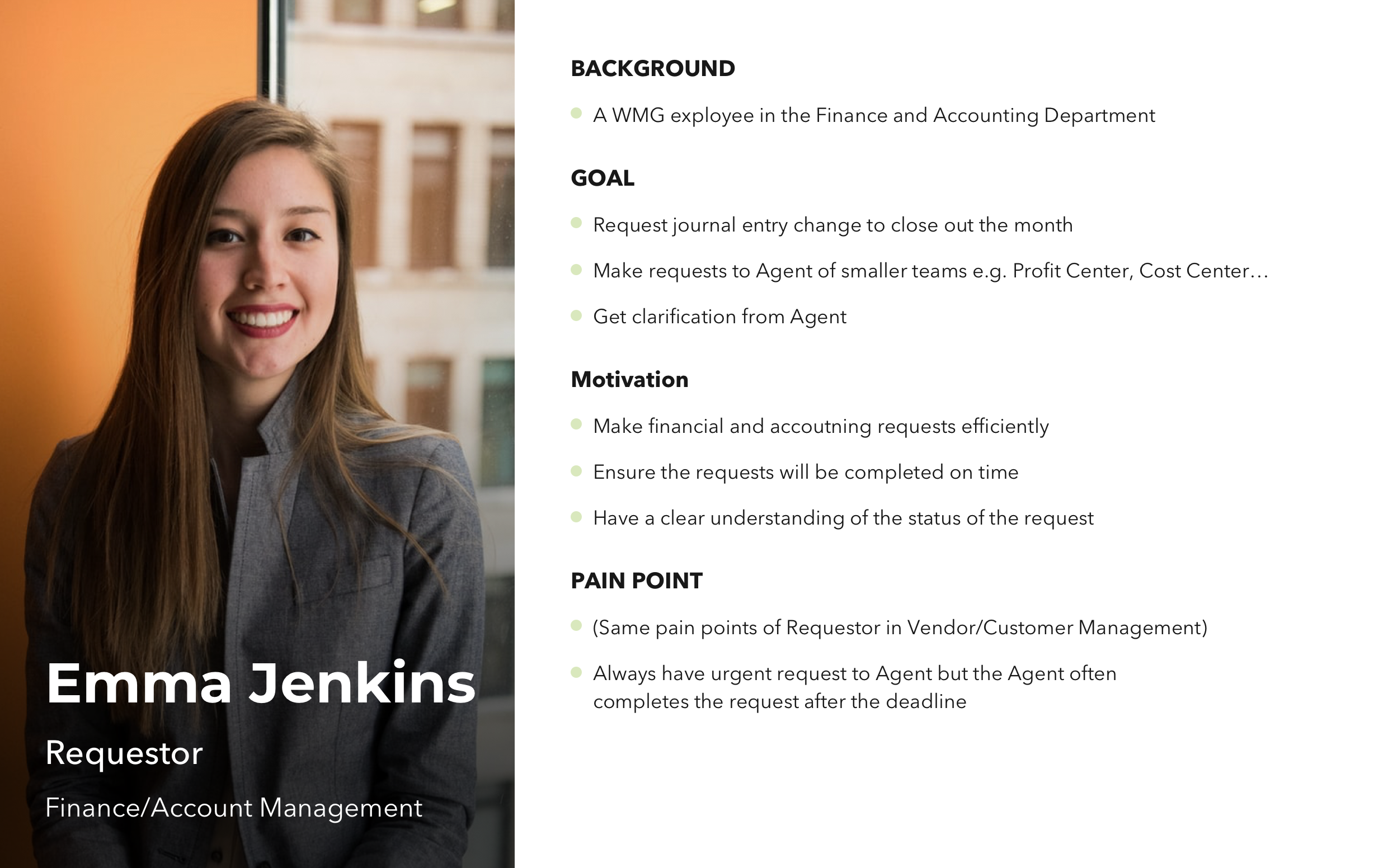
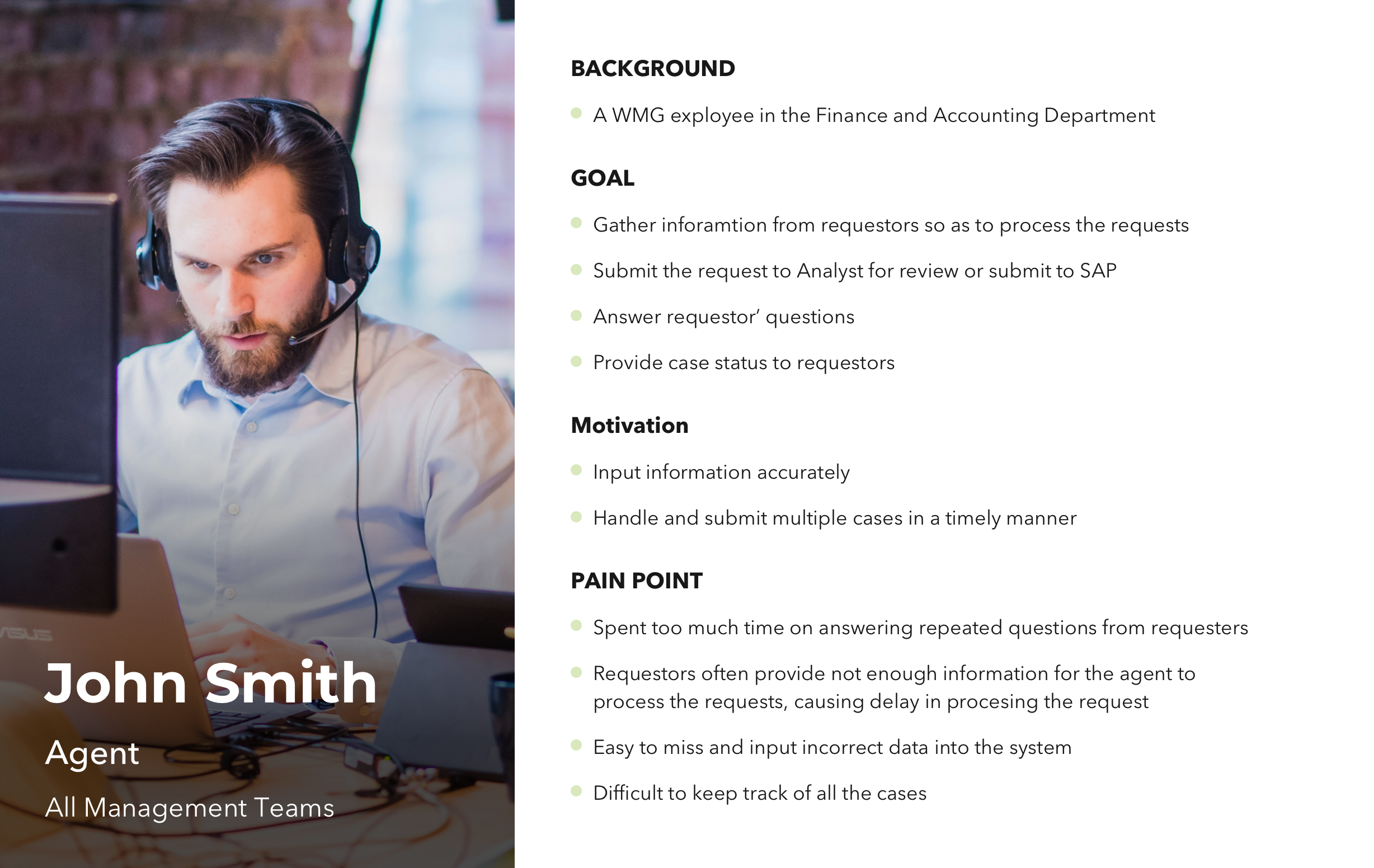
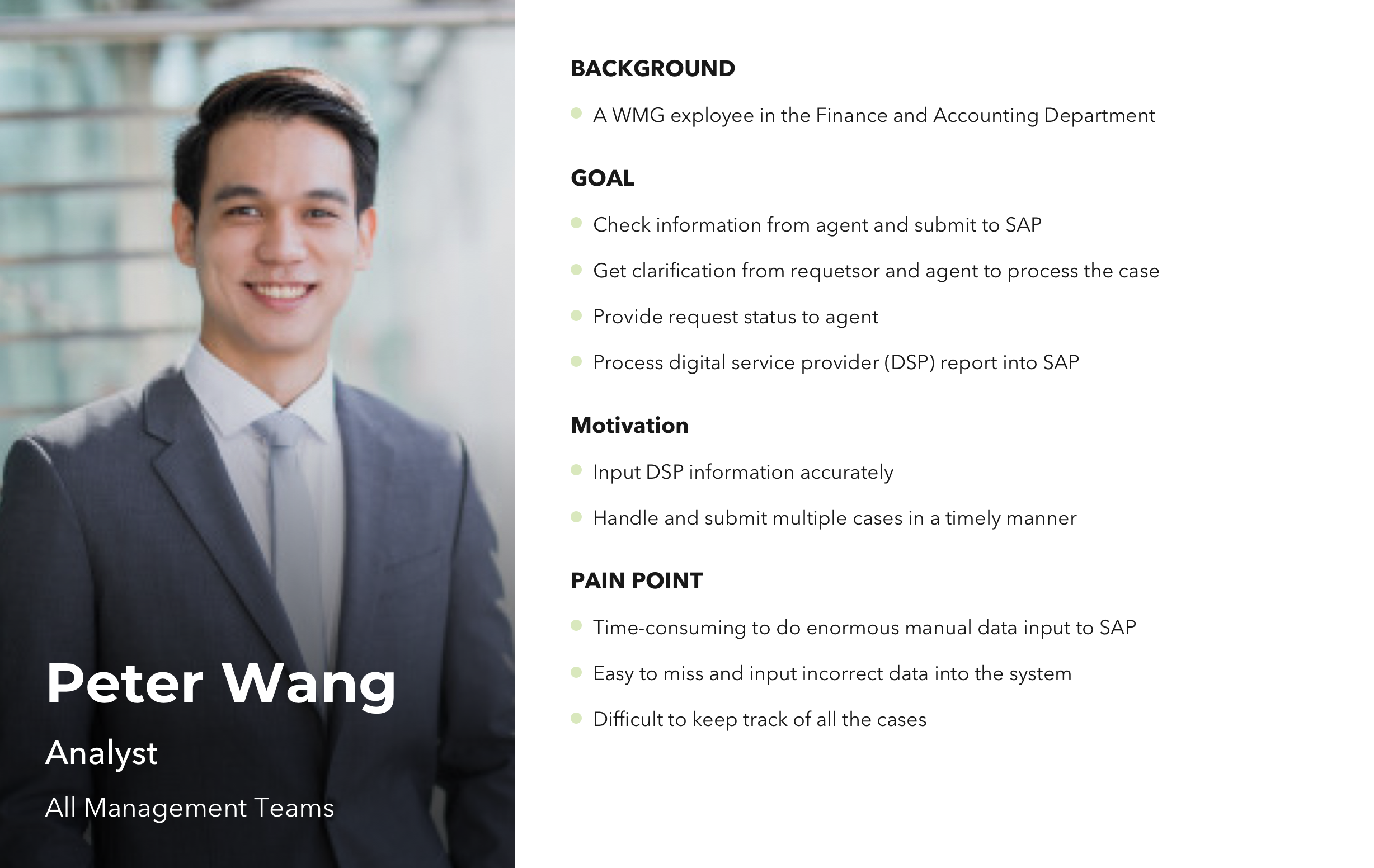
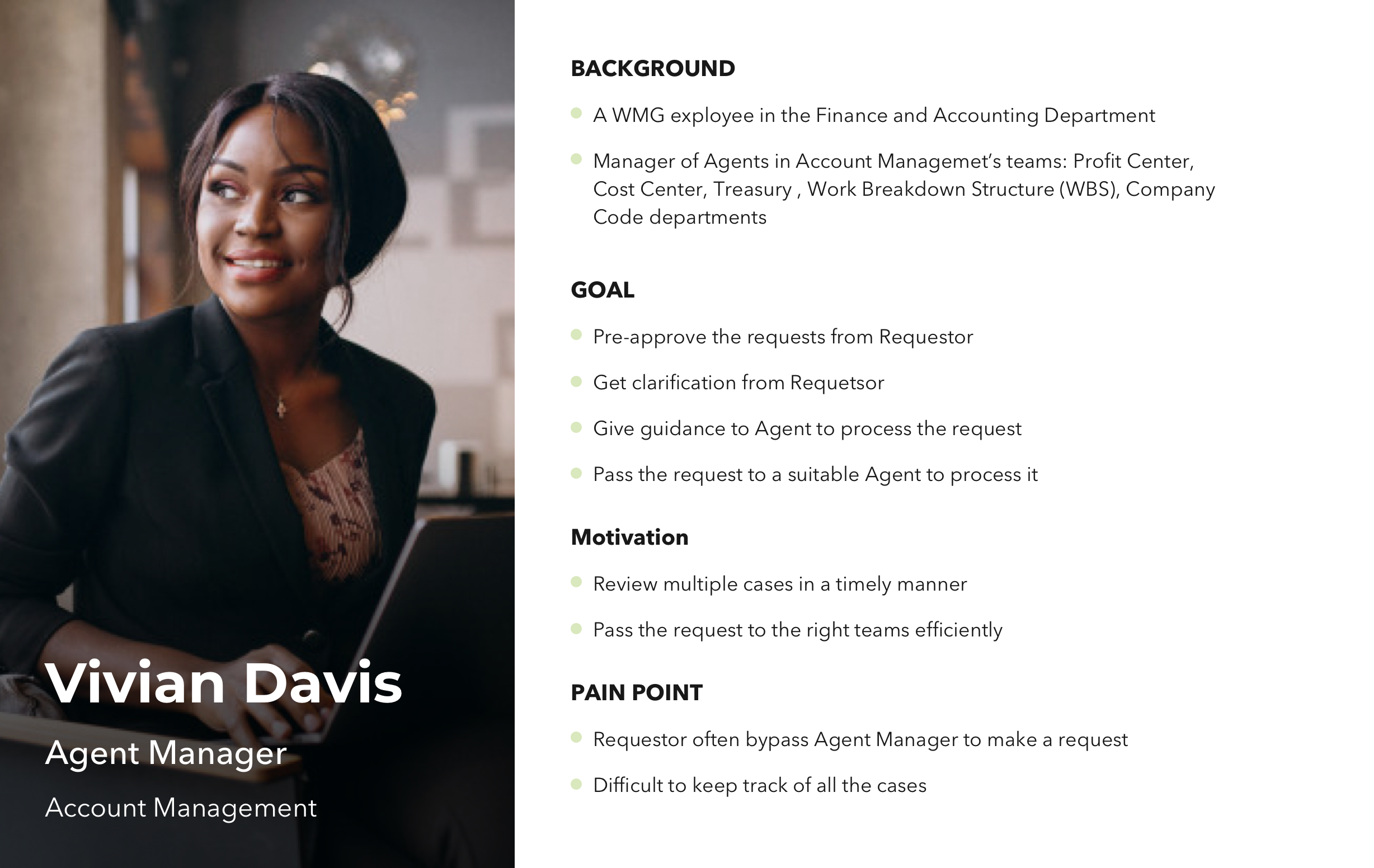
I took a further step to learn about the needs and pain points of each key position in the Finance and Accounting department.
Key findings:
Requestors in Vendor/Customer emphasize on effective communication and capturing the details, while Requestors in Finance/Account focus on efficiency and meeting the deadline.
Agents face many issues when they handle the request, e.g. they always need to answer the same questions from Requestors and follow up with them repeatedly for obtaining further information.
Analysts find it time-consuming for the enormous amount of manual data entries.
Agent Managers think it is frustrating that Requestors often do not follow the proper workflow, sometimes the Requestors bypass them to make a request
All of them want to have better communication and an easier way to keep track of all the cases
Design Goals
After analyzing all the needs and pain points, this project aimed to
Create an all-in-one case management system that
supports the Requestor to ask questions and submit finance/accounting requests
empowers the Agent, Analyst and Manager to manage requests systematically
Enable Requestor to do self-service via chatbot and knowledge base
Initiate automation in their DSP file processing
Ideation
User Flow
Case Management
To create a Shared Service Center, I consolidated all the workflows across departments.
Requestors can come to one single place to submit requests and ask questions to different Finance and Accounting departments.
Based on the request and question type, the system will automatically route the case to the appropriate Agent/Agent Manager. Guided by the system, they can pass the case to the Analyst to complete the tasks.

Chatbot
These flows define how should we guide the Requestor to submit requests or ask questions effortlessly while making sure the Agent would obtain all the necessary information to complete the tasks. The Requestor can also speak to an Agent in a live chat.
In the first phase, Chatbot would only support the Vendor and Customer Departments.

Automation in File Processing
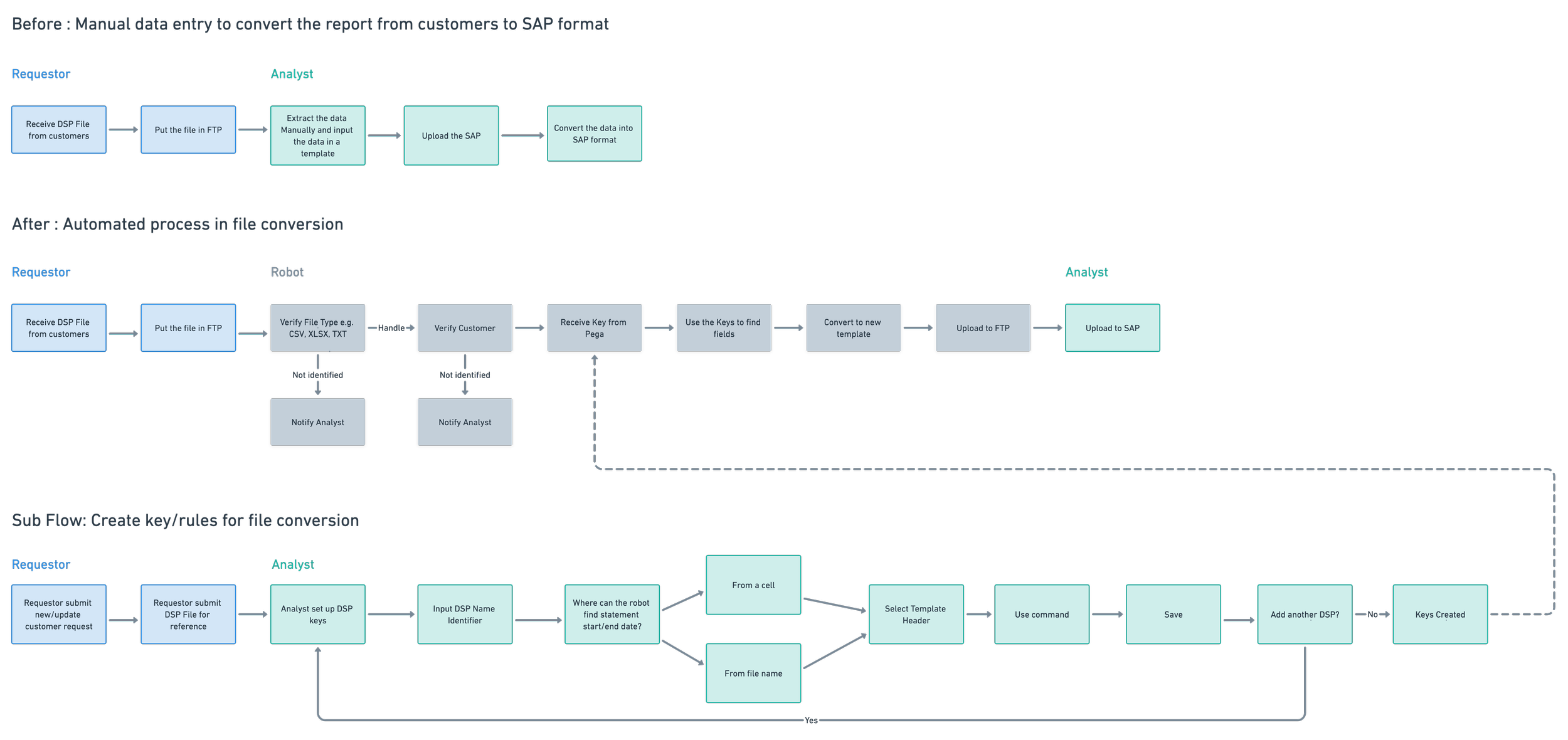
One of the major tasks of the Analyst in the Customer Department was to convert the Digital Service Report into SAP format. With hundreds of reports coming every month, it required a long time for data entry.
Working with the developers, I created a new automated file processing flow. Analysts just need to set up rules/keys for the file conversion at the beginning. The robot would be able to convert all the files into SAP format automatically, which would greatly reduce time and labor cost.
Design
Mid-fidelity Wireframes and Prototypes
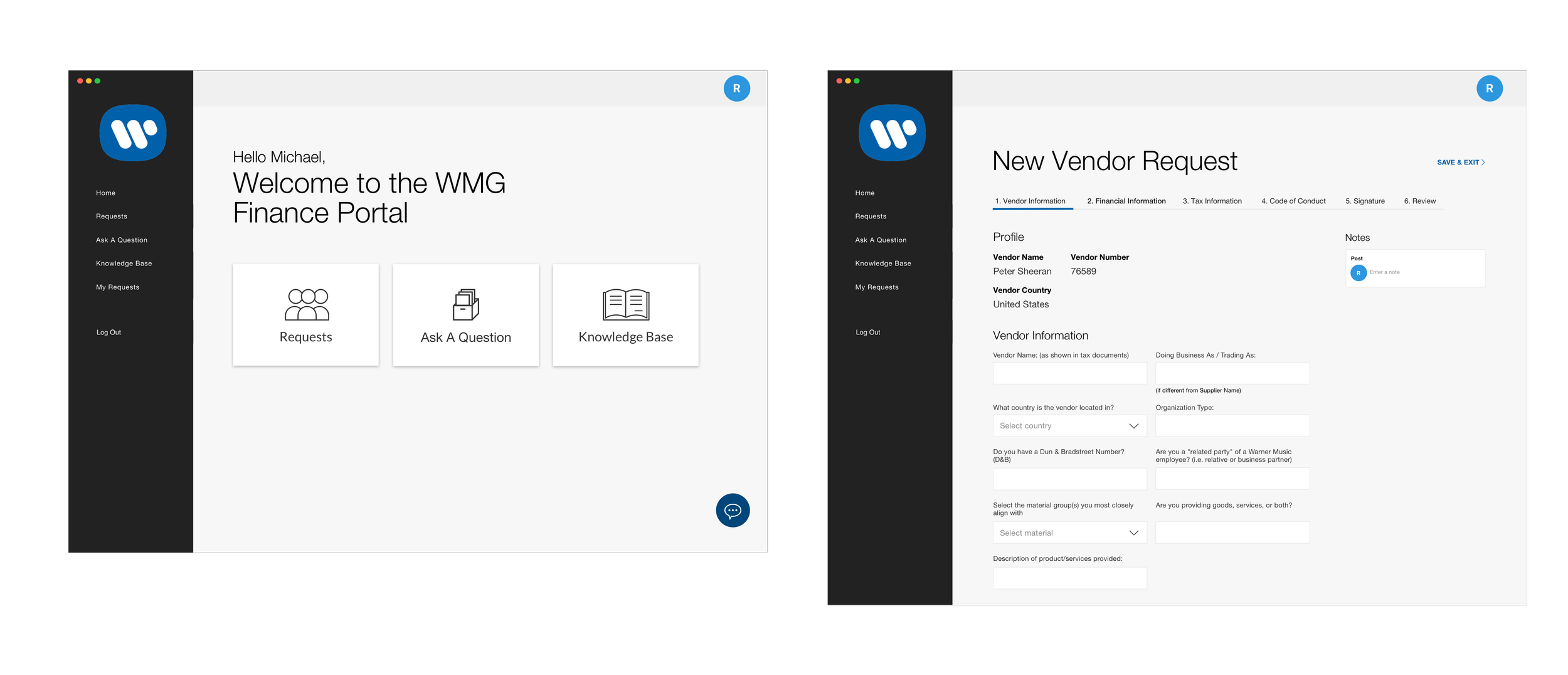
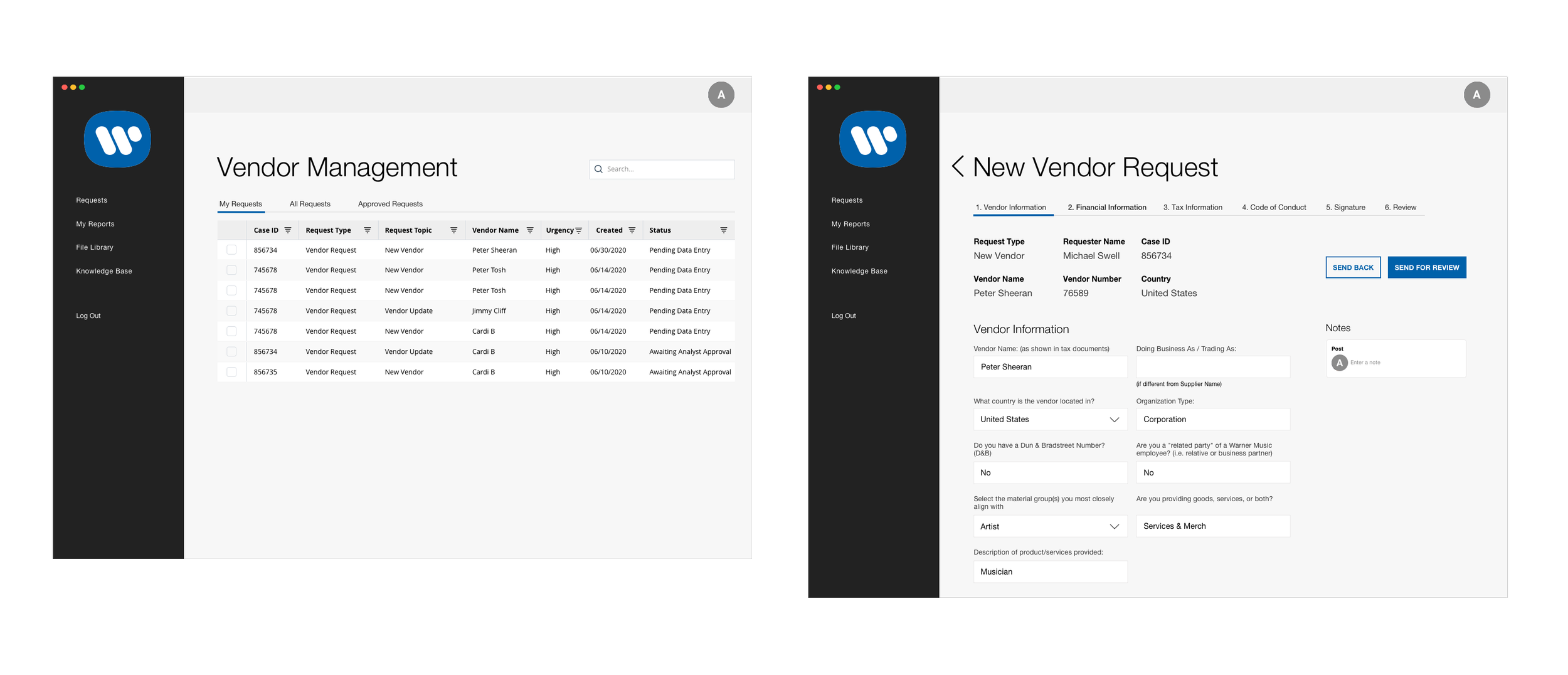
We started with mid-fidelity wireframes and prototypes to get initial feedback from the clients.
Below are examples of the Requestor and Agent’s wireframes:
Example of the Chatbot’s prototypes:
Final Design
With the Agile development process, I received feedback from Warner Music after each sprint, and I made rapid iterations to enhance the design. At the end of the project, I spent three months performing user testing with each persona to identify issues. After all the iterations, here is the final design of the major screens:
Case Management System
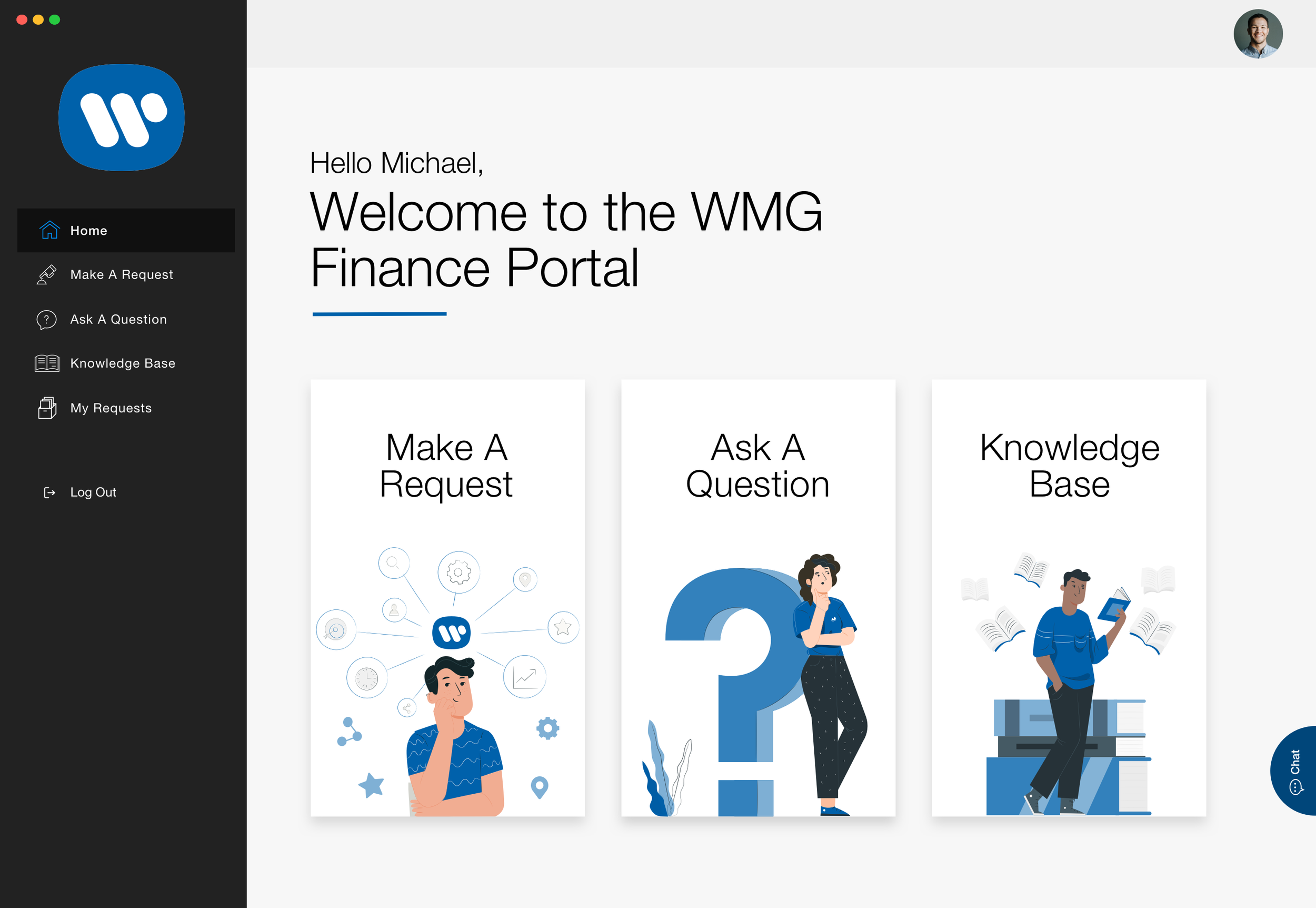
Homepage
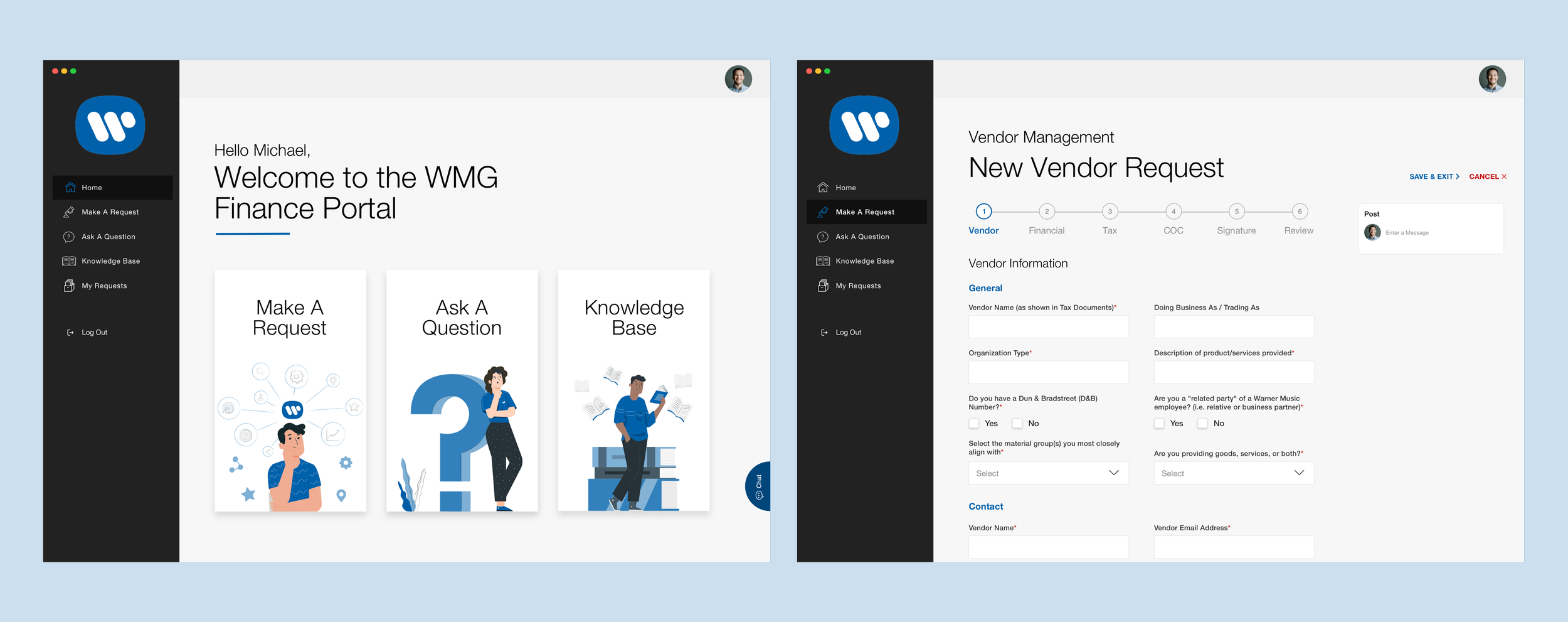
Internal system does not have to be dull, it could be a fun and engaging environment. One of the cost-saving ways to create an interactive platform is by adding illustrations.
Vendor/Customer Management -
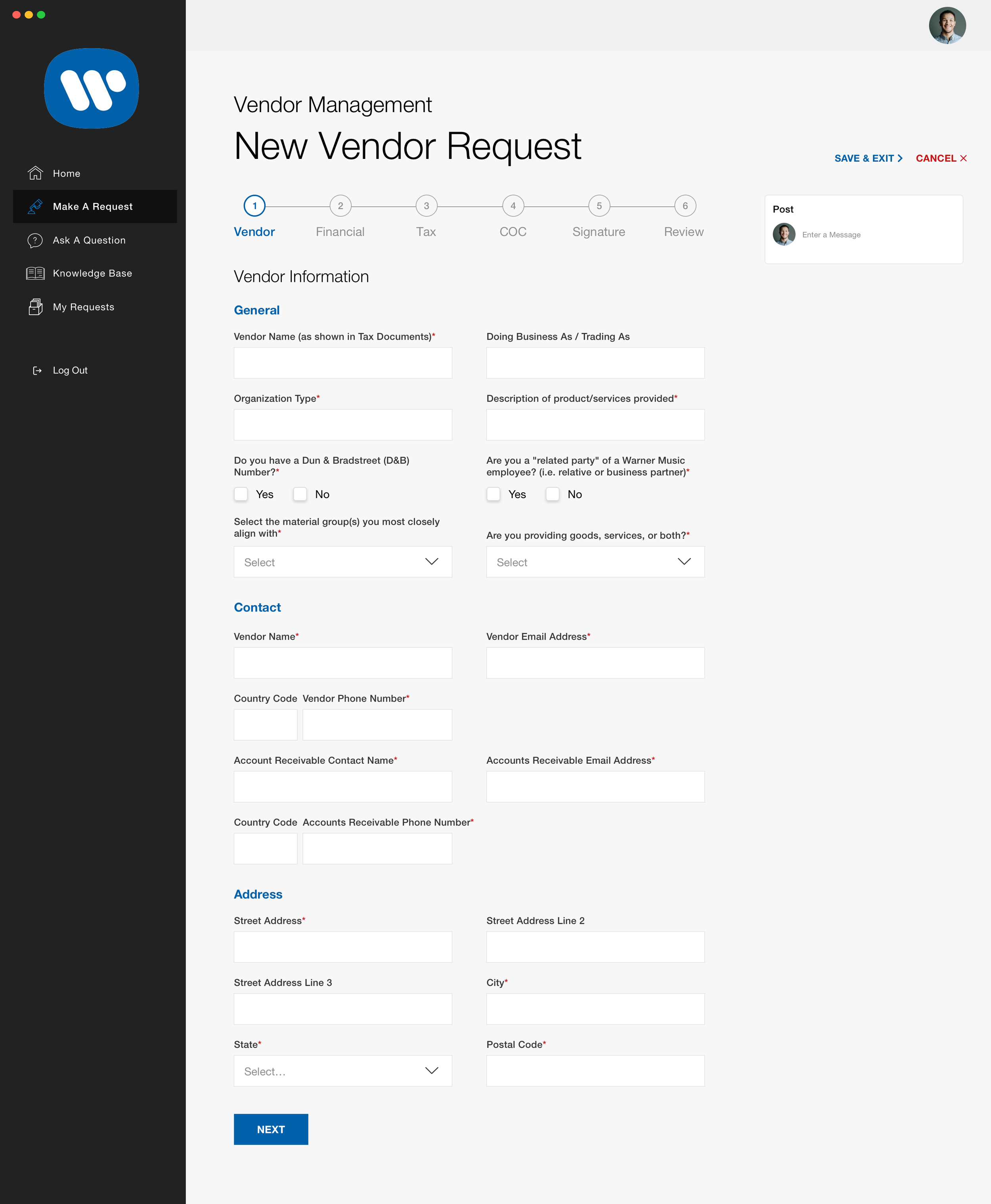
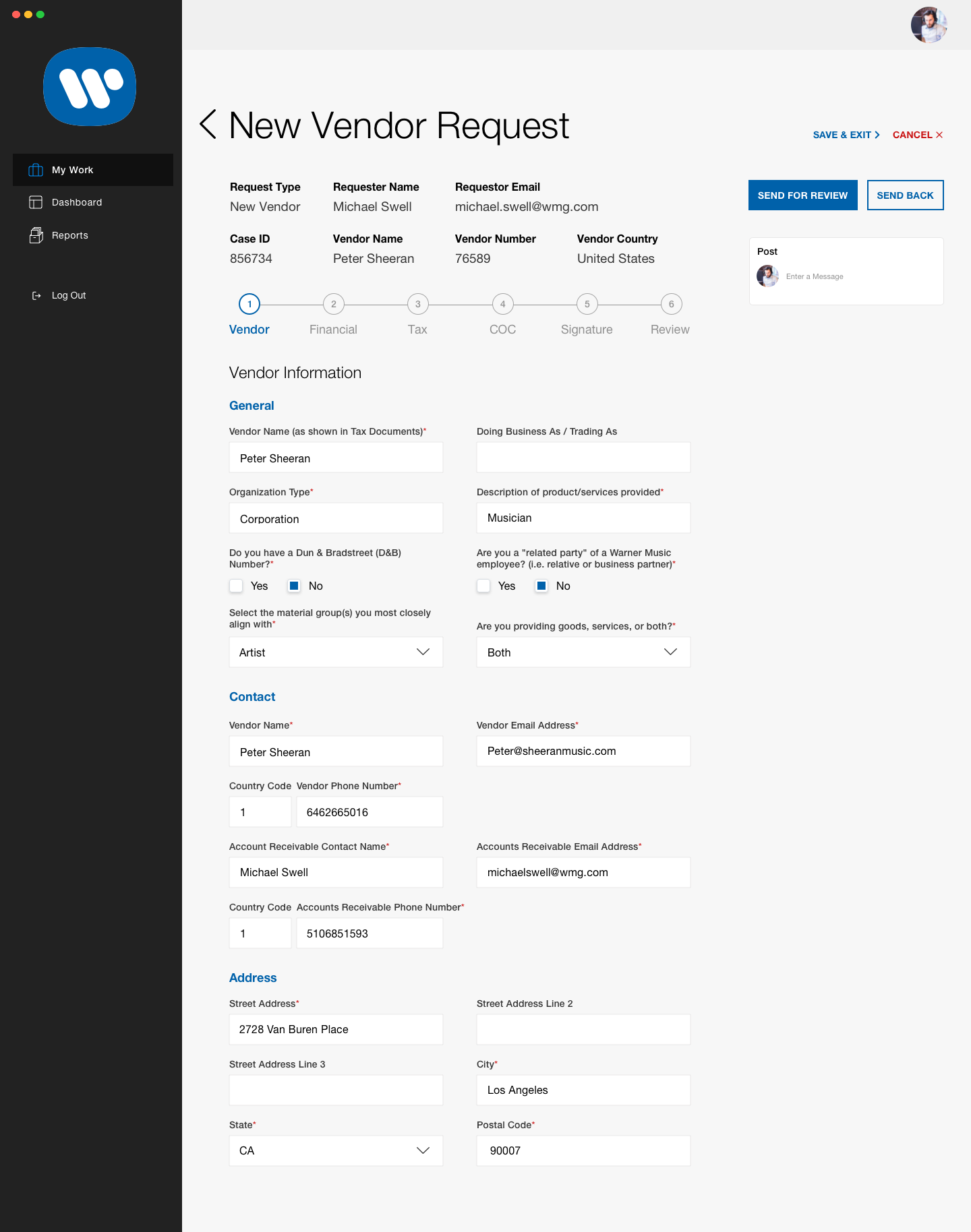
New Vendor Request
To avoid missing information and unnecessary back-and-forth communication, I created step-by-step progress for Requestor to create a new vendor. There is a progress bar guiding the users and all the fields are organized into different sections for clarity purposes.
For Agent and Analyst, they can review the information submitted by Requestors and make editions easily.
Vendor/Customer Management -
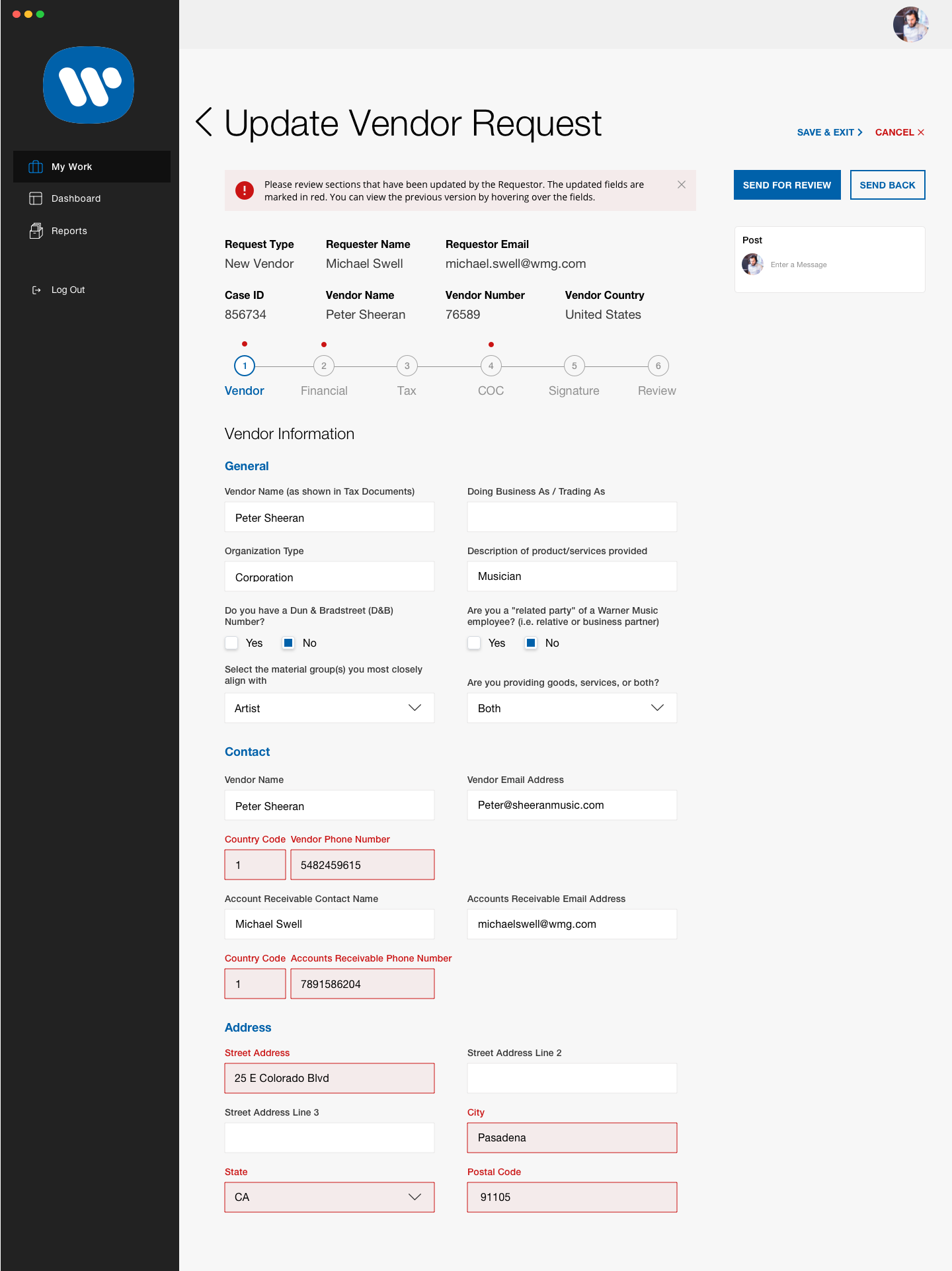
Update Request
To ensure the Agent/Analyst can review the updated information effortlessly, I highlighted the updated fields in red and allow the Agent/Analyst to hover over the fields to check the previous version.
Finance Management -
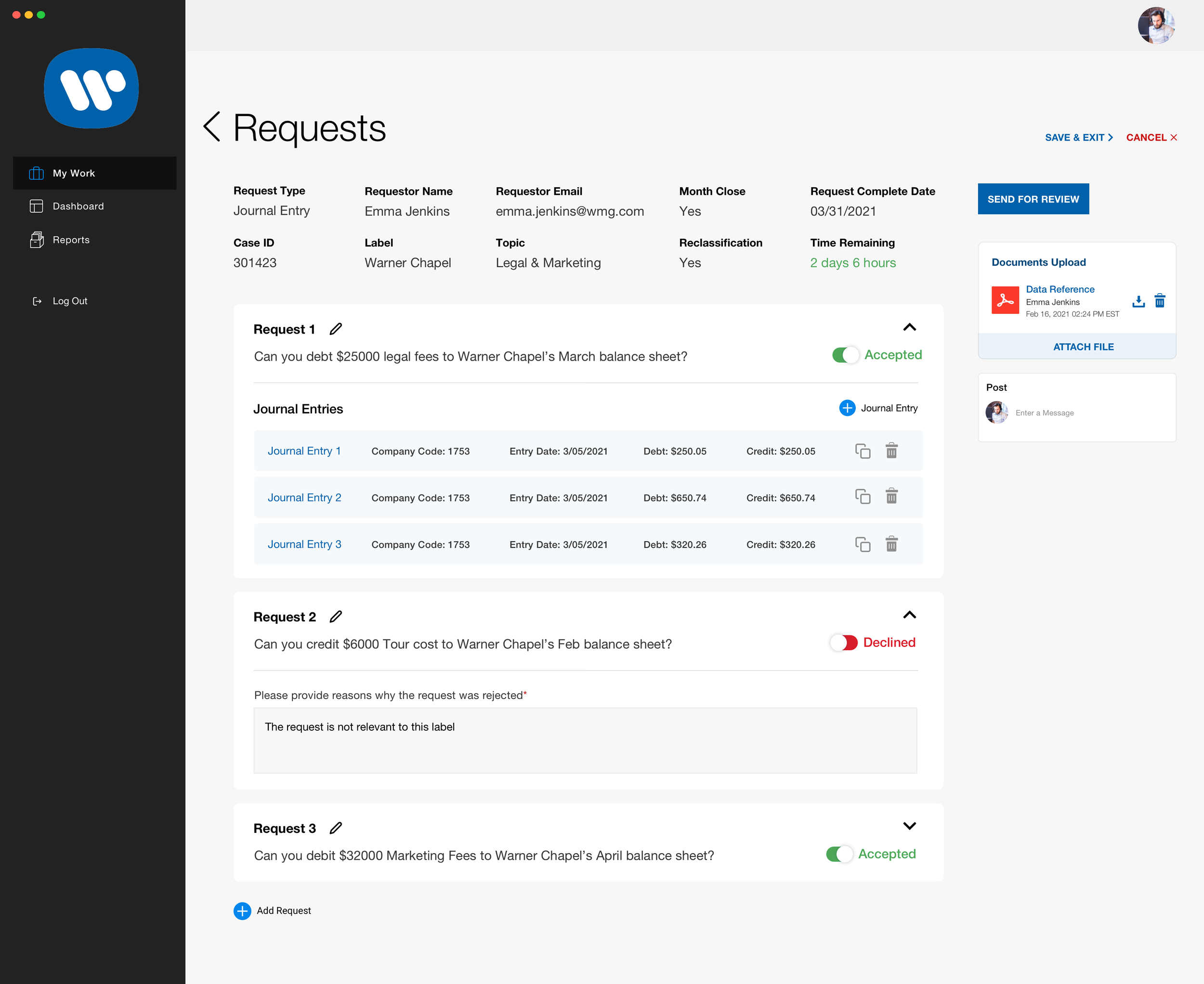
New Request
For Requestor, they can submit multiple requests and for each request, Agent/Analyst often needs to make several journal entries. To build a clear information hierarchy, I used a card design allowing the Agent/Analyst to review each request and make journal entries easily.
Finance Management -
Journal Entries
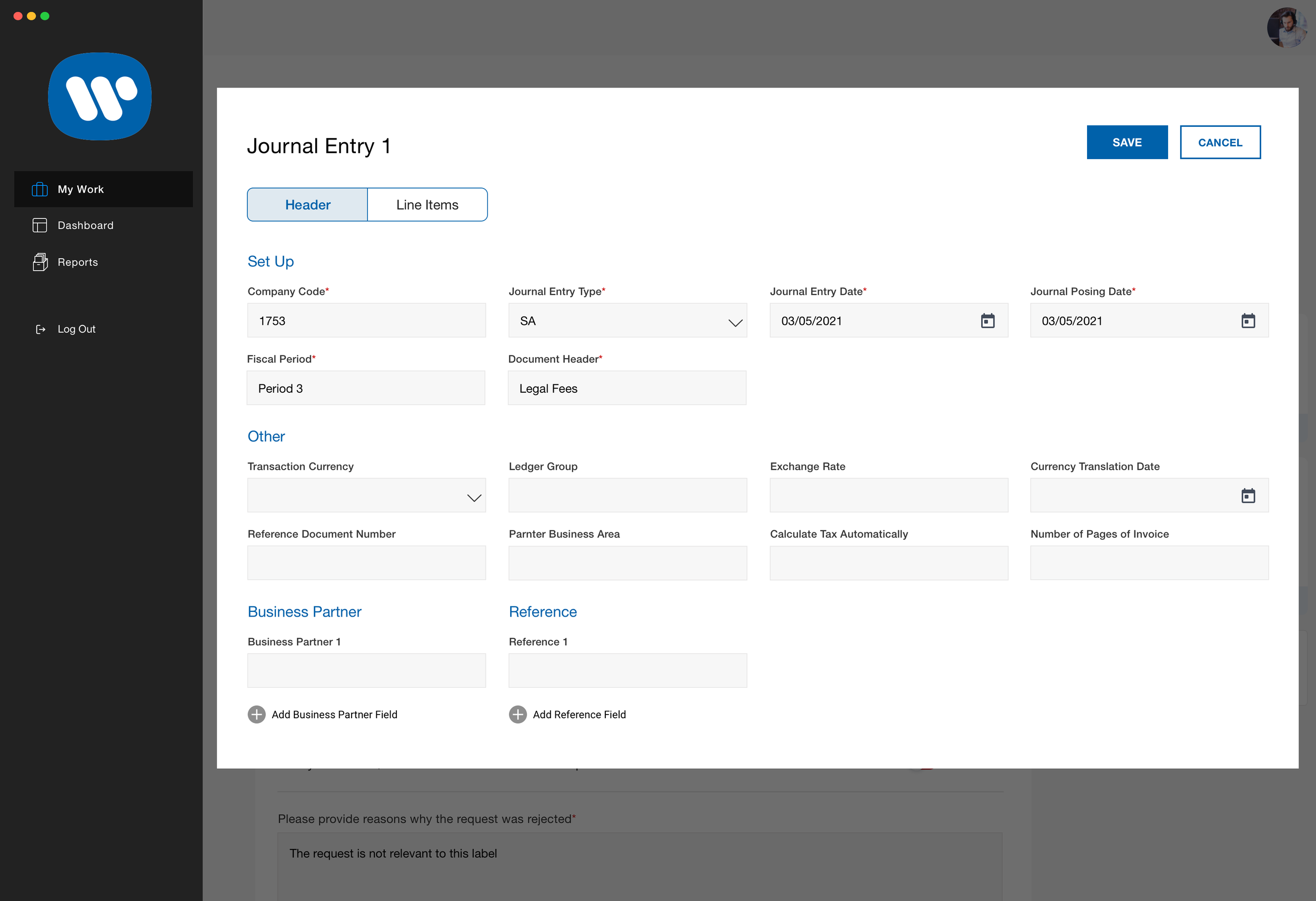
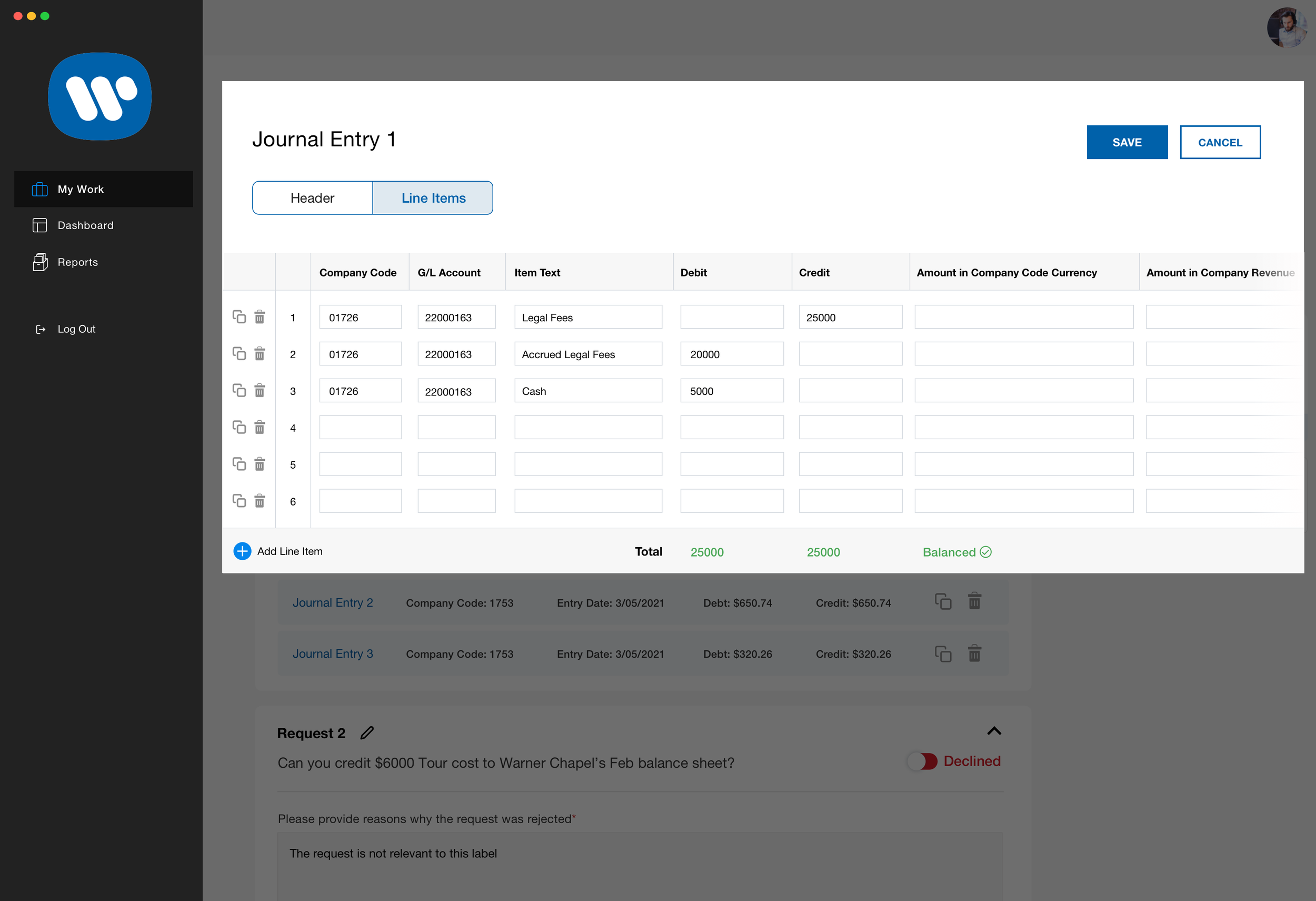
For Agent/Analyst entering the journal entries, I adopted a form design for the “Header” section but a table design for “Line Items”. The “line items” fields are interrelated, a table design will allow users to compare data line by line easily and efficiently.
Accounting Management -
New Request
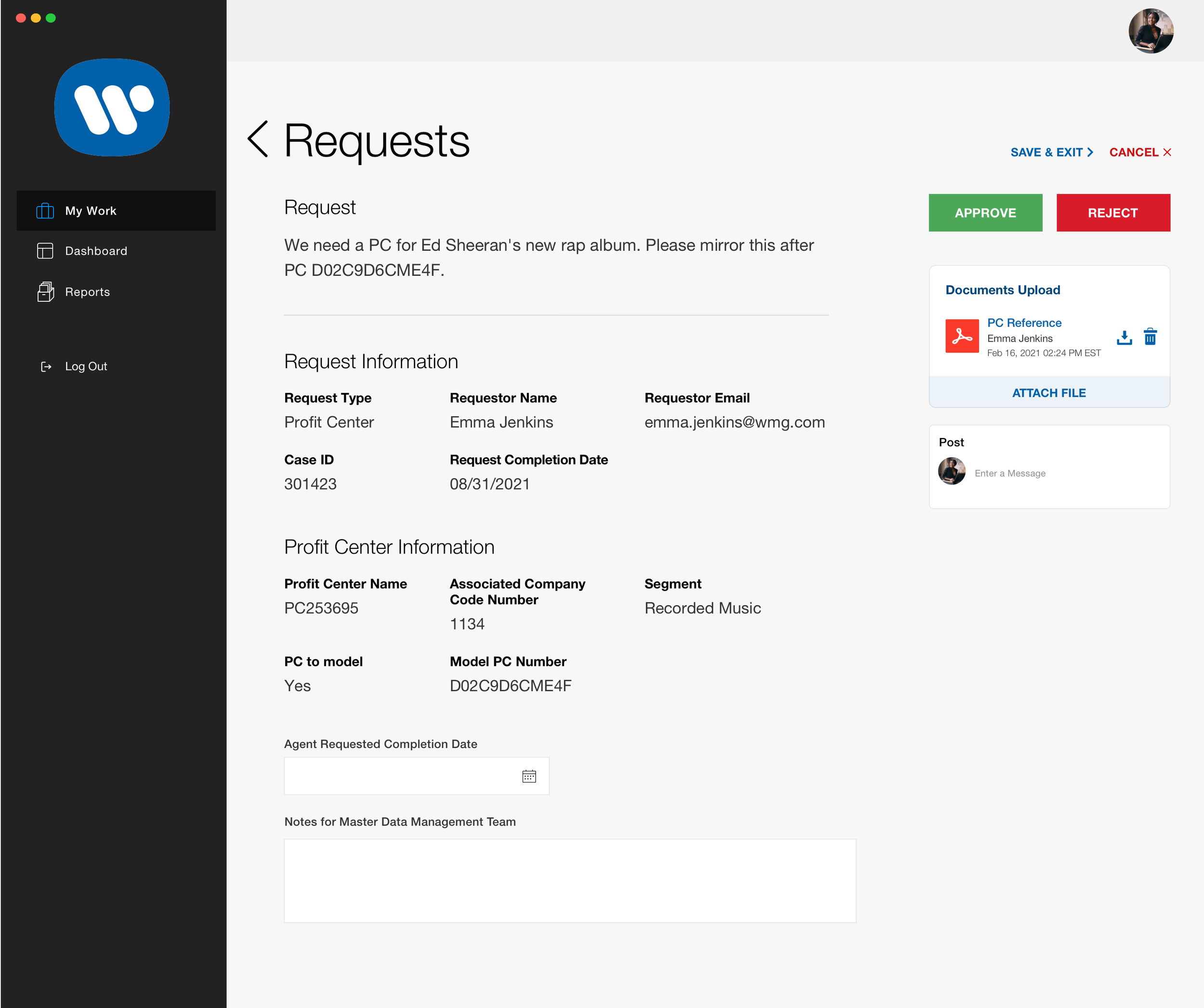
Agent Manager focuses on quickly reviewing the request instead of processing it. Therefore, I placed the request at the top and the detailed information at the bottom to enhance efficiency.
Self-Service
Chatbot
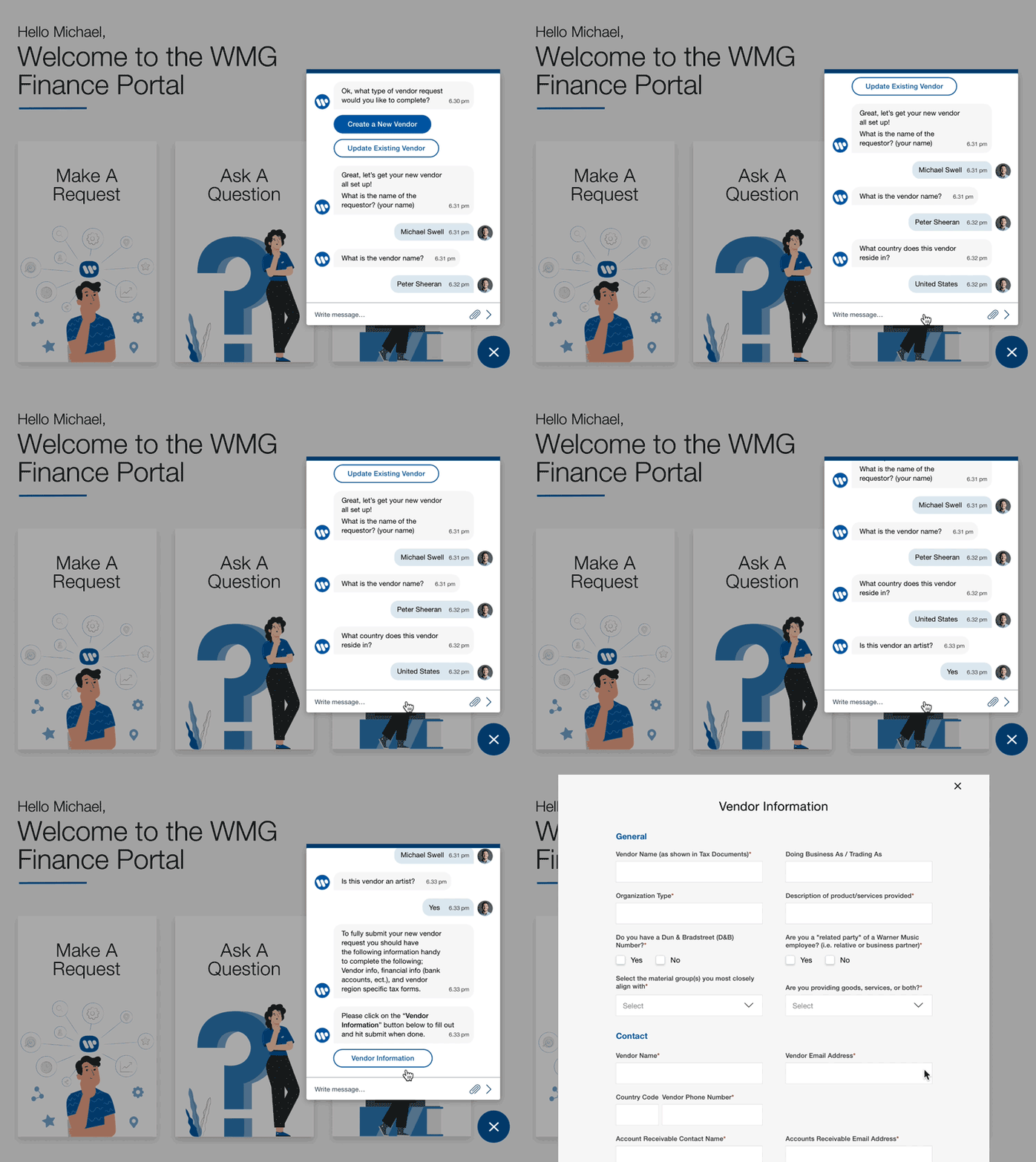
I created a Chatbot to guide the Requestor to complete vendor/customer creation and updates. If the Requestors faced any issues, the Agent could jump in and provide immediate help, which greatly enhances users' engagement and satisfaction.
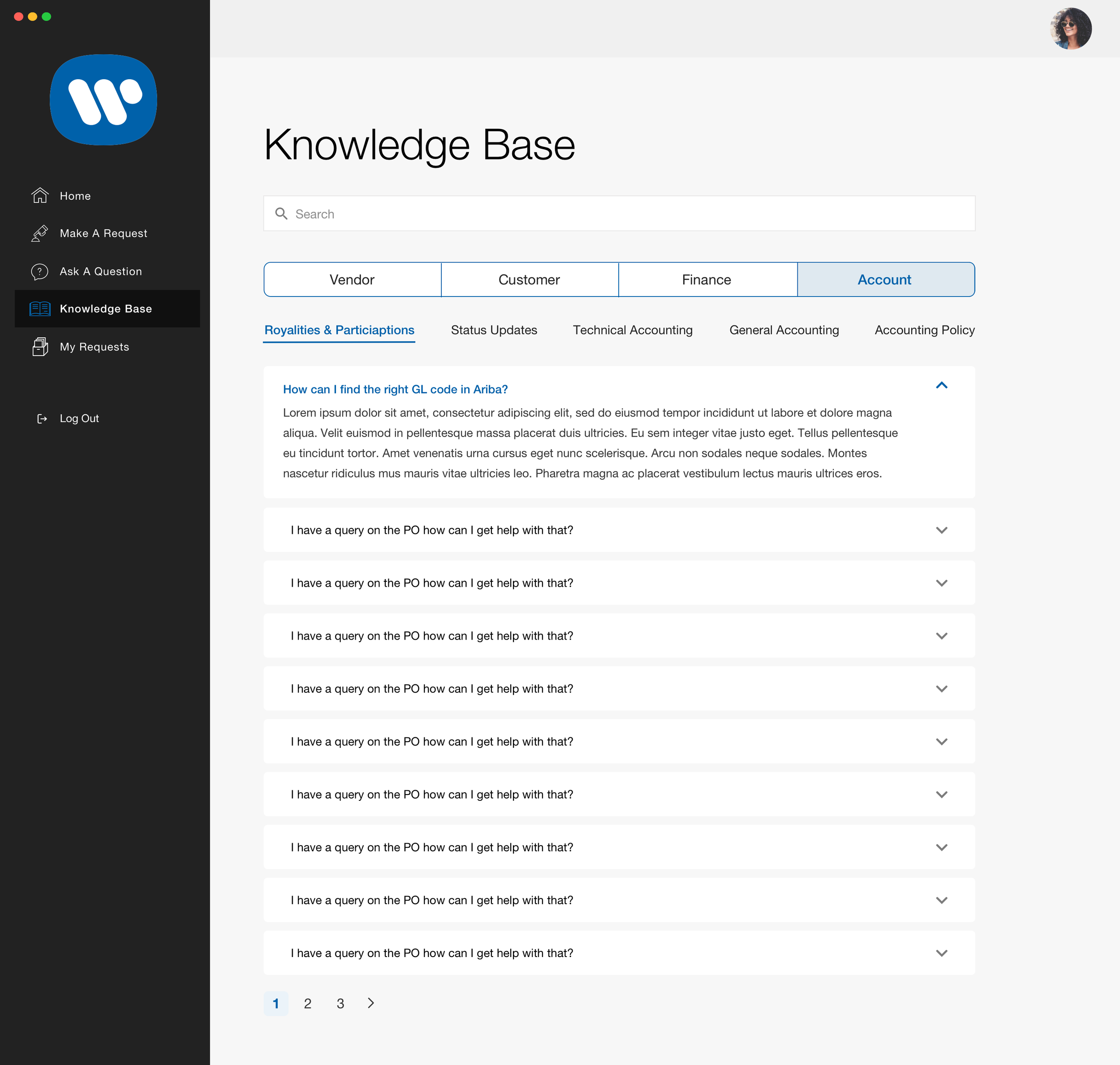
Knowledge Base
I created a knowledge base to support the Requestors to find answers themselves before reaching out to an Agent, which can reduce the number of cases.
Automation
File Processing -
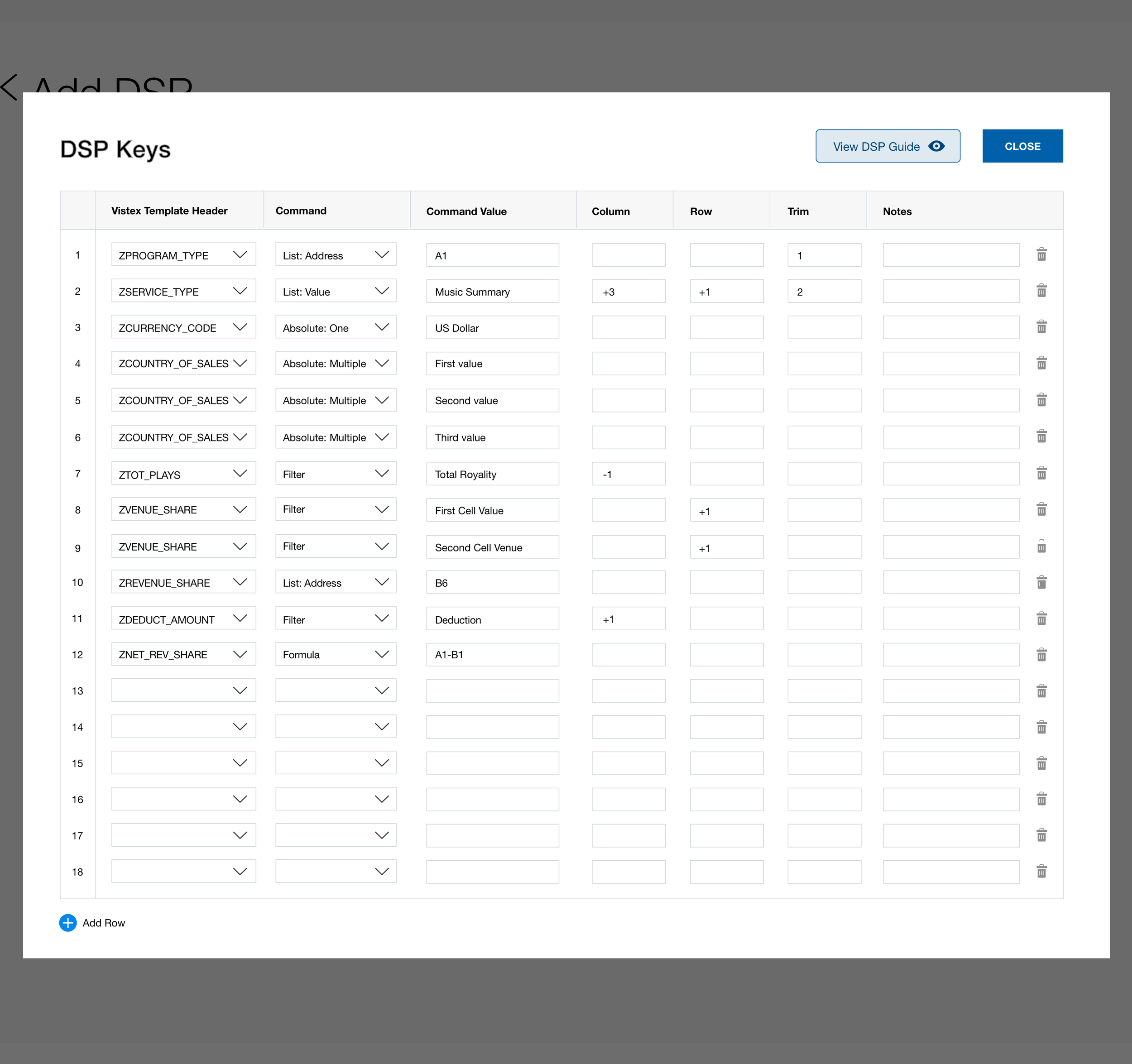
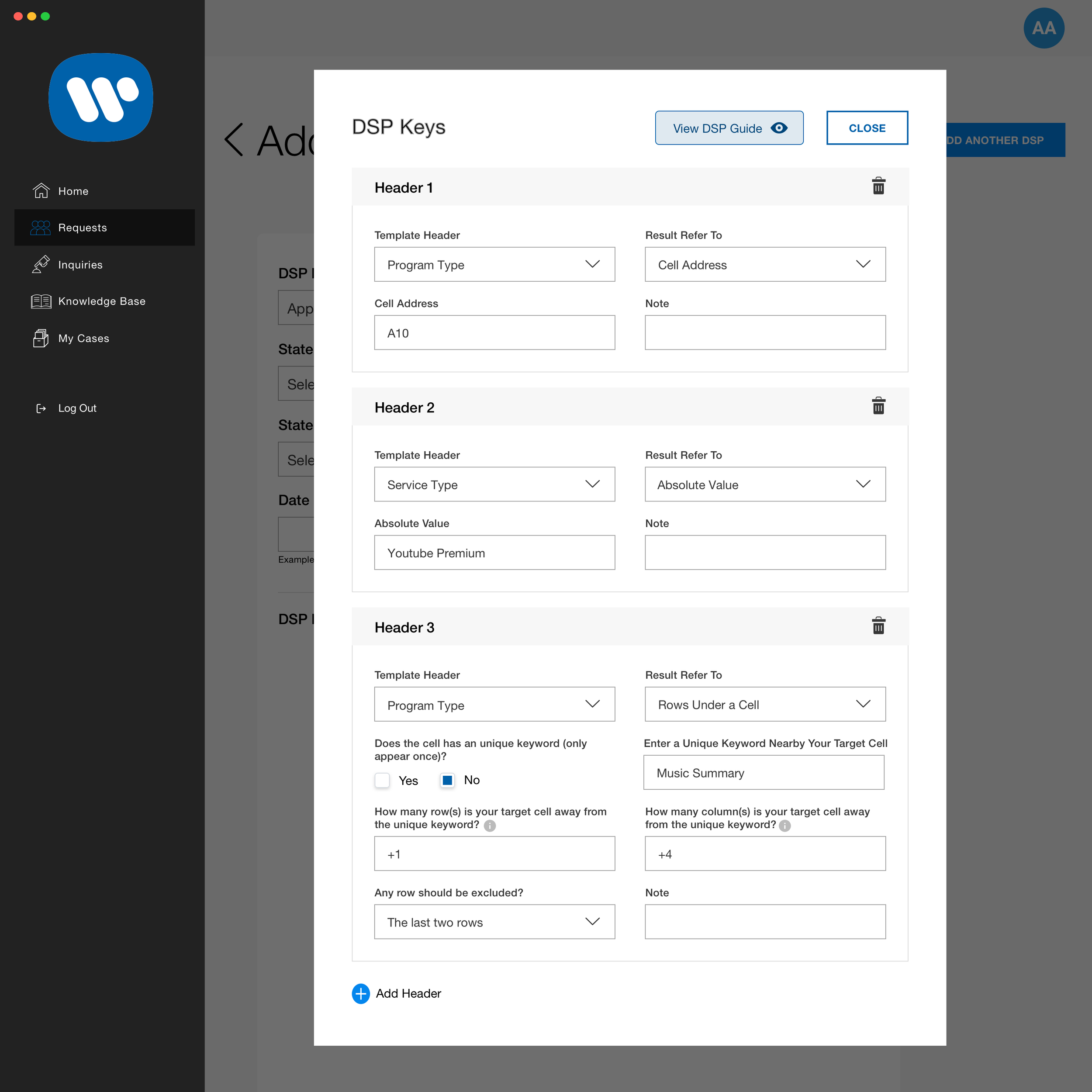
Set Up DSP Keys
Initially, I used a table design allowing the Analyst to set up the DSP keys efficiently. As they are all new to the rules, I created a DSP Guide to instruct them.
However, from the user testing, we learned that most of the users would not like to spend time reading the DSP Guide. To tackle this issue, I changed the table to a form design that step-by-step guides the users to set up the keys. Compared to the table, it took a longer time for them to finish the tasks but we achieved a higher task completion rate.
Conclusion
Prior to this project, Warner Music had no standardized system to manage its internal customer service. Each department has its unique workflows and expectations in handling the requests. With in-depth research and ideation, I designed an all-in-one Case Management System, a Chatbot, and a new automated file processing experience.
In this journey, I learned the importance of balancing business goals and user expectations. Design meant to enhance efficiency by reducing steps may end up hurting users if they do not conform to the existing mental models.
Also, sometimes there were conflicts between meeting specific user needs and maintaining overall UI consistency. It is important to prioritize user experience and think of alternative UI solutions in the design.